
WordPress plugin suite
The WordPress plugin you install on every site
One plugin to install, and inside it modules you switch on one at a time: cookie consent, SEO, SMTP e-mails, redirects and 404s, media, security, maintenance. A module that is off does not load a single line.
7 days free Try nexya Pro, no card needed. Newsletters, forms, invoices, the WooCommerce checkout and everything that goes further, on your site for seven days.-
Selling online
PDF invoices
Invoices, delivery notes and the Swiss QR-bill, attached to WooCommerce e-mails.
nexya invoice -
Selling online
Checkout page
A step-by-step WooCommerce order, a cart on the side and suggestions at the right moment.
nexya checkout -
Talk to your visitors
Forms
Conditional forms over several pages, with participants to add: every entry kept on the site.
nexya forms -
Talk to your visitors
Multilingual site
Every page in every language, an address per language, and the site’s texts translated in one place.
nexya translate -
Talk to your visitors
Popups
An announcement, an offer, a closure: shown at the right moment, between two dates.
nexya popup -
Get found
Page cache
Each page kept as a file and served before WordPress even loads.
nexya cache -
Talk to your visitors
Newsletters
Newsletters written on the site, with your posts in them, sent in the background.
nexya mailya -
Stay compliant
Visitor statistics
Audience figures measured by the site itself, with no third-party service and a single cookie set after consent.
nexya aris -
Stay in control
Custom fields
Your own fields, in their own tables, read back in a single query per page.
nexya custom fields -
Stay in control
performance
What each page costs the site, and the settings that lighten it: a query monitor on every page,…
nexya performance -
Stay in control
Maintenance
Close the site during an intervention, slim down its database, take a copy.
nexya maintenance -
Stay compliant
Security
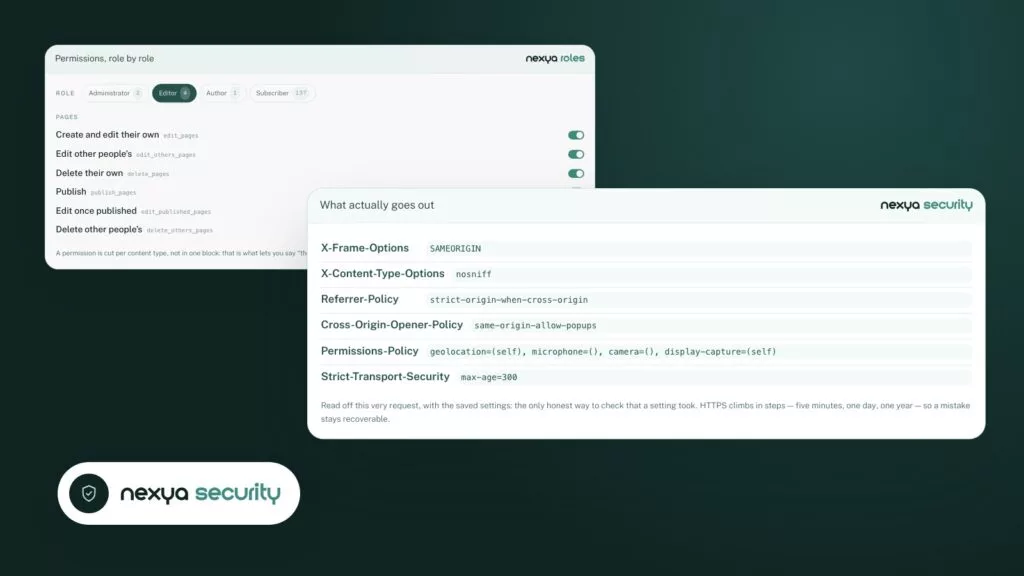
Security headers in place, and an alert when an installed plugin has a known vulnerability.
nexya security -
Stay in control
Media library
Thumbnails rebuilt in the background, and in Pro folders to sort the images.
nexya media -
Get found
Redirects and 404s
Every broken address logged, and in Pro the redirect suggested before you even look for it.
nexya redirects -
Talk to your visitors
Reliable e-mails
The site’s e-mails really go out, and you know why when one fails.
nexya mail -
Get found
SEO
Titles, descriptions, sitemap and share previews, checked before publishing.
nexya seo -
Stay compliant
Cookie consent
Nothing runs before the visitor agrees: no scripts, no videos, no remote fonts.
nexya cookie -
Stay in control
History of changes
Who changed what, and when, with the value before — and in Pro the button to go back to it.
nexya activities -
Stay in control
Roles and rights
Rights you can finally read, and a menu cut down to what each person really needs.
nexya roles -
Stay in control
Shortcuts
Duplicate, reorder, add: three gestures right on the content lists.
nexya shortcuts -
Stay in control
Dashboard
A clear admin: menus cut down to what matters, and in Pro your colours right through to the login page.
nexya dashboard
How it works
One extension, modules inside
-
1
One extension to install
nexya installs like any other WordPress extension, and brings everything else together in a single panel.
-
2
Modules you turn on
Cookie consent, SEO, emails, redirections: each is a module in this extension. Turn it on if needed, leave it off otherwise.
-
3
A turned-off module loads nothing
When turned off, a module registers no hooks: no requests, no scripts, not a single line in the site header.
-
4
Lower costs
A single extension to update instead of a dozen, and a single license instead of as many subscriptions. Less time spent maintaining the site, less money spent running it.
The demo
A look at the nexya WordPress plugins in action
The suite
One panel, modules you switch on one by one
One module per need: cookie consent, SEO, SMTP emails, redirects and 404s, change log, roles, media, security, maintenance. You turn them on one by one, from the same panel
A suite, not a collection of extensions
What changes when you keep everything in one place
As many different tasks, as many extensions to do them. The work itself doesn't change — everything around it is what costs: licenses to track, updates that don't communicate with each other, settings scattered across just as many menus, and a client who has to learn just as many interfaces to manage a single site
nexya
- Licenses
- One license, one date, one invoice
- Settings
- A single panel, and the modules inside
- Updates
- Just one, tested with the others before release
- Code loaded
- Nothing at all as long as the module is turned off
- The client
- A vocabulary, written for them
- When things break
- An address
Multi-extensions
- Licenses
- As many renewals, accounts, and invoices
- Settings
- Each extension places its menu wherever it wants
- Updates
- So many to track, and nothing guarantees they work well together
- Code loaded
- Whatever the author intended, whether you use it or not
- The client
- As many writings, as many ways to name the same thing
- When things break
- As many contacts, as many response delays
And on your site?
Security, e-mail, sharing, speed and queries: five free tools look at your site as a visitor would and tell you what to fix. No sign-up.
In figures
What the gap costs, spread over a year
The two columns above state the nature of the problem. The two measurements that follow give its order of magnitude, based on intentionally low assumptions — detailed below the charts.
21 modules
in a single extension, enabled as needed
72 updates
fewer checks, per site and per year
76 % of time saved
to get a new site up and running
24 h fewer maintenance hours
per year, for 10 maintained sites
- 12 h 5 sites
- 24 h 10 sites
- 48 h 20 sites
- 72 h 30 sites
- 120 h 50 sites
The work the modules do does not change. What changes is how many times you have to revisit them: one extension to check instead of seven, at every cycle, on every site.
The gain is not visible on a single site. It is visible across a portfolio of sites, and it grows with it.
On a new site, each extension requires installation, its key, its settings, and compatibility checks with the others. A single panel replaces all these steps with one: turning on what the site needs.
It is the only figure on this page measured with a stopwatch rather than by the year.
Estimates, assumptions included: 2 minutes of checking per plugin and 6 minutes of setup, for 7 plugins instead of one. Licence renewals are not counted.
Pricing
Free forever.
The modules run on as many sites as you like, for nothing. Pro takes over what repeats, and its price per site drops as you run more of them.
Free
CHF 0 forever
Unlimited sites
Every module of the free version.
1 site
CHF 99 / year
99.— per site
License for one site
5 sites
CHF 399 / year
79.80 per site
The first clients
20 sites
CHF 799 / year
39.95 per site
An established agency
Unlimited
CHF 1499 / year
2 months free
15.— from 100 sites per site
Sliding: 30.— at 50 sites, 7.50 at 200, 3.— at 500
Nothing left to count
One licence activates Pro on every module. No add-ons, no module to buy separately. Every plan can be tried free for 7 days.
Free and Pro
Free WordPress plugins you can ship on a client site
A free plugin that is useless is not free, it is a demo
Each module has a free version that is sufficient to maintain a WordPress site: the banner consents and blocks, the log records, and 404s are tracked. Nothing is restricted to the point of becoming unusable.
The Pro version adds what you need when managing twenty sites rather than one: replaying an action, importing three hundred redirects, keeping the fingerprint of each file. The Pro version installs over the free one—your settings remain
Where it comes from
Plugins built in an agency, for its own WordPress sites
nexya did not come out of a market study. These are the modules an agency installed on every site it delivered, written because the existing plugins did too much, or not enough, or asked the client to understand WordPress.
They ran in production for years before being sold
The stance fits in one sentence: a client should never have to know what a role, an HTTP header or a 301 redirect is for their site to be right.
Anything the agency can decide once, it decides. What is left is written in the client’s language, not the code’s
The Pro version
What the Pro licence switches on in every module, from the cookie banner to redirects
The free version supports one site. The Pro license activates, within the same modules, what a serious site eventually requires: a cookie banner in your colors and service-by-service consent, pattern-based redirects and CSV import, conditional forms with PDF export, Mailya newsletters, page caching, a second sending server with failure alerts, email letterheads, media folders and WebP conversion, file fingerprinting, and a longer log retention. A single license for the entire extension: you install the Pro version, and your settings remain
Blog
The latest article
 · 5 min read
Hacked WordPress site: steps to clean it and prevent reinfection
Webshells in the media, administrators created by a stranger, infection returning after cleanup: what order to act in, what you must do yourself, and what nexya does next to close the doors.
Read the post
· 5 min read
Hacked WordPress site: steps to clean it and prevent reinfection
Webshells in the media, administrators created by a stranger, infection returning after cleanup: what order to act in, what you must do yourself, and what nexya does next to close the doors.
Read the post