nexya mail
The site’s e-mails actually go out — and you know which ones did not, with the exact reason the server gave
- No more messages in the spam folder A fixed sender, consistent with the domain, and a matching return path. That is what most sites whose contact form “does not work” are missing
- Thirteen methods, eleven of them by API SendGrid, Brevo, Mailgun, Postmark, Resend and the others go through their API over HTTPS. It works even when the host closes the outgoing SMTP port, which has become the norm
- The log keeps only the failures No copy of everything that goes out, only what failed: the reason given by the server, the headers and the body. A red badge counts them in the menu
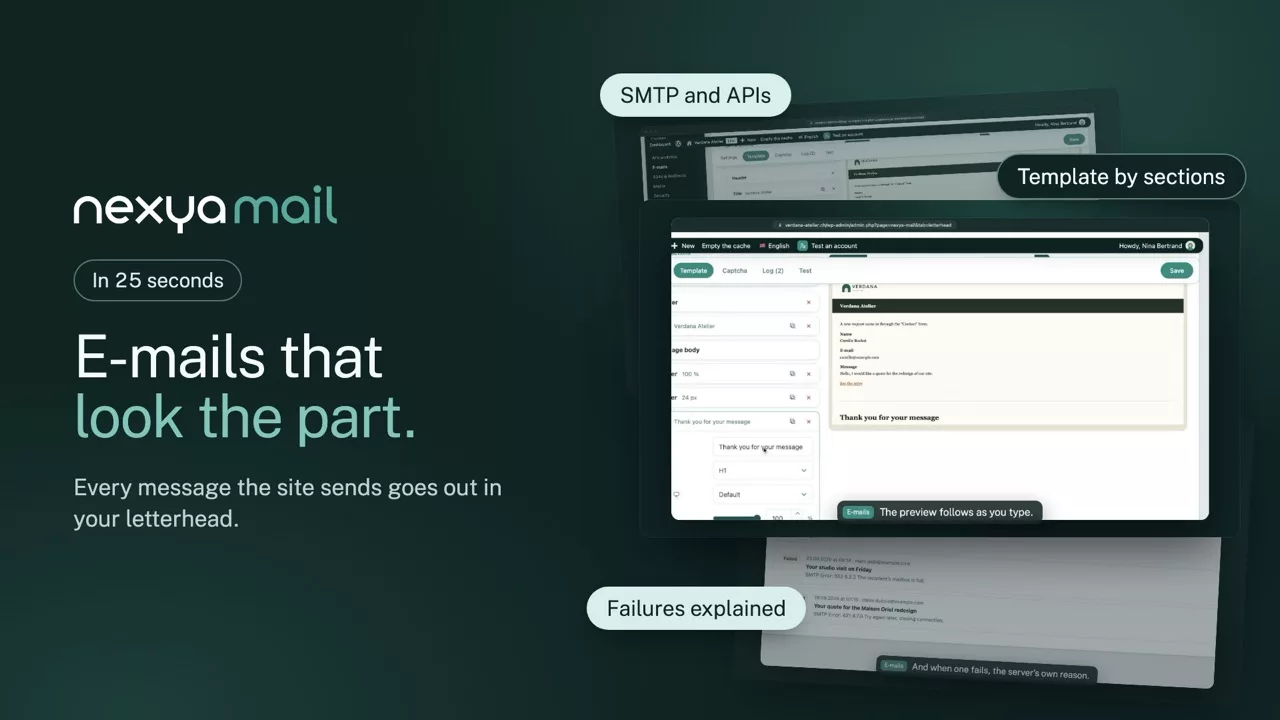
- A test send that actually tells you something The test message states the address and the method used. When it fails, you read the server’s answer, not “an error occurred”
-
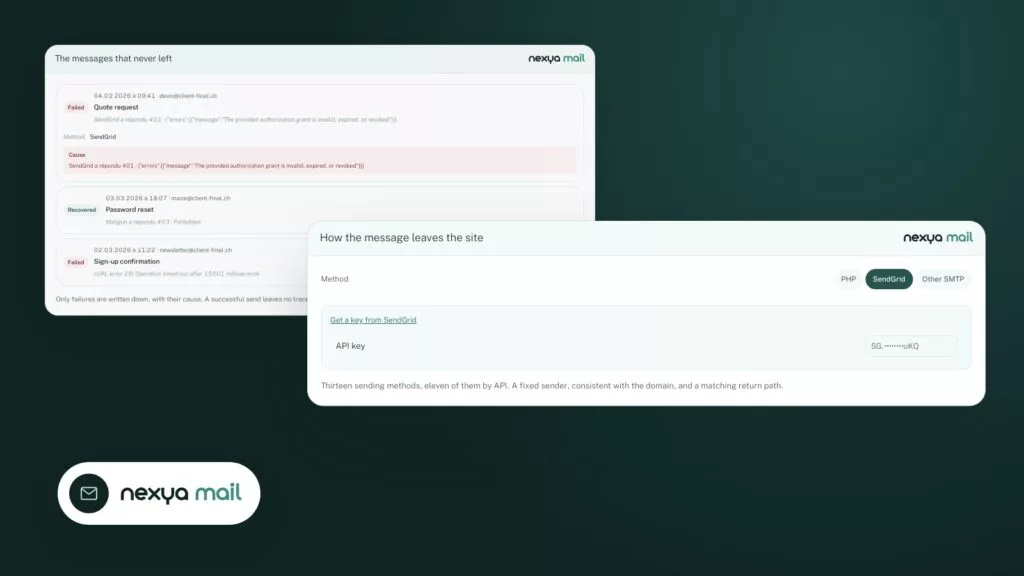
Cause SendGrid a répondu 401 : {"errors":[{"message":"The provided authorization grant is invalid, expired, or revoked"}]}
-
Cause Mailgun a répondu 403 : Forbidden
-
Cause cURL error 28: Operation timed out after 15001 milliseconds
Only failures are written down, with their cause. A successful send leaves no trace, and the journal tab carries the count.
WordPress goes through the server’s mail() function. That is the one that fails most often on shared hosting.
Get a key from SendGrid
Any SMTP server: the host’s, Gmail’s or Outlook’s. Simple, but the outgoing port is sometimes blocked.
Thirteen sending methods, eleven of them by API. A fixed sender, consistent with the domain, and a matching return path.
Why a site’s e-mails get lost
By default, WordPress writes its messages with PHP’s mail function, from an address like wordpress@your-domain that nobody has authorised to write on the domain’s behalf. Modern filters check that authorisation and file the message as spam, or refuse it. The site, meanwhile, believes it was sent. The module removes both causes: a real sender address, and a real sending server.
Why APIs rather than SMTP
More and more hosts close the outgoing SMTP port to limit abuse. A perfectly correct SMTP configuration then fails with no readable explanation. API sends go over HTTPS, on the same port as a web page: they work anywhere the site works.
What the log holds, and what it strips
Only failures are kept, with the cause, the headers and the body of the message — enough to understand without having to reproduce it. Keys and tokens are stripped from addresses before saving, so that a readable log does not become a place where credentials sit around.
Free
Fixed sender, thirteen sending methods, failure log
Pro
Alert when a message did not go out, long retention, second sending server
The suite