
nexya seo
What the site tells search engines about itself — and what it shows when its address is pasted somewhere. Written once, applied everywhere, checkable before you publish
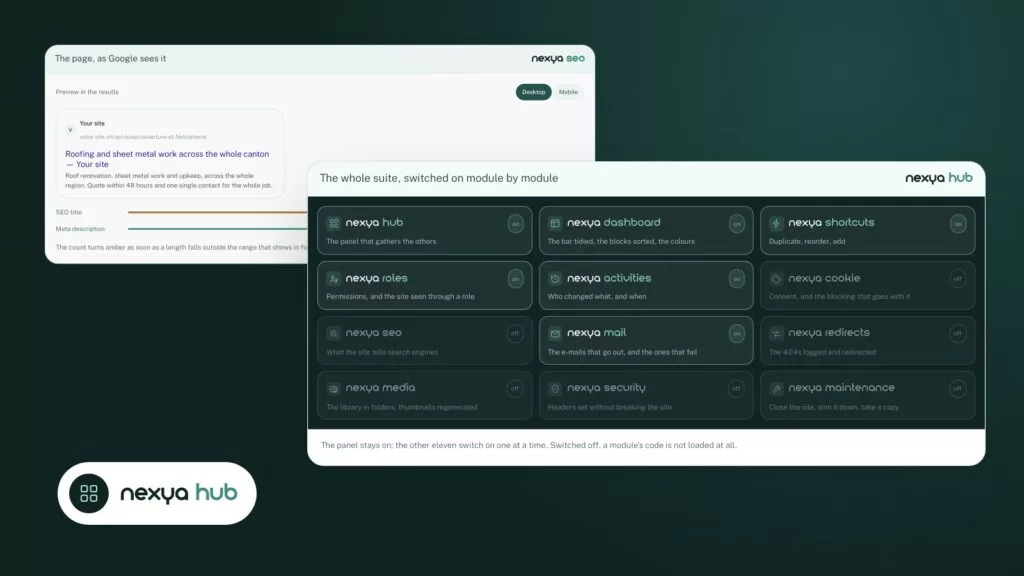
- The result before you hit publish The page as it will come out in Google, in desktop and mobile, with a count of the characters that actually fit. You fix a title that is too long before it gets cut, not three weeks later
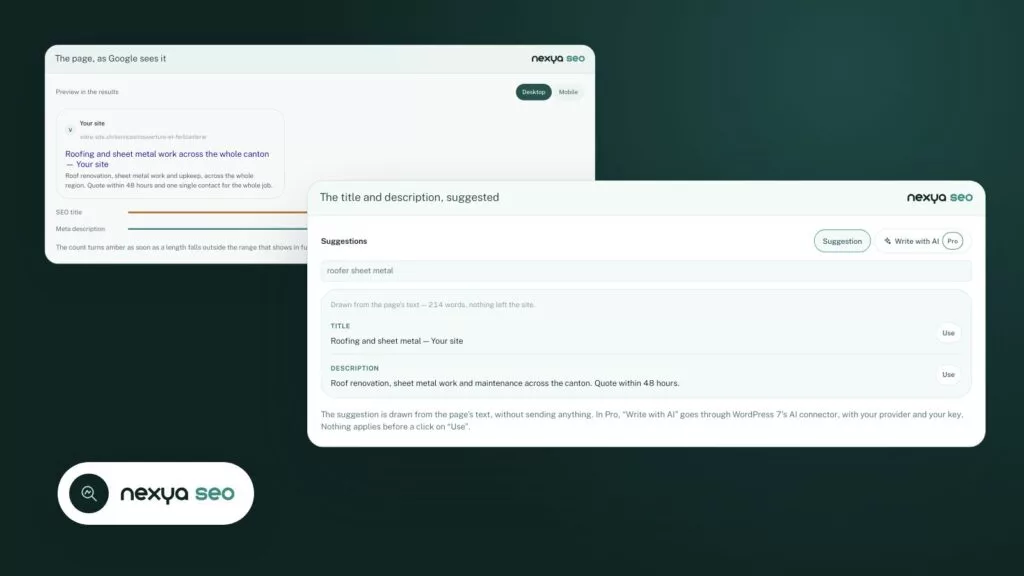
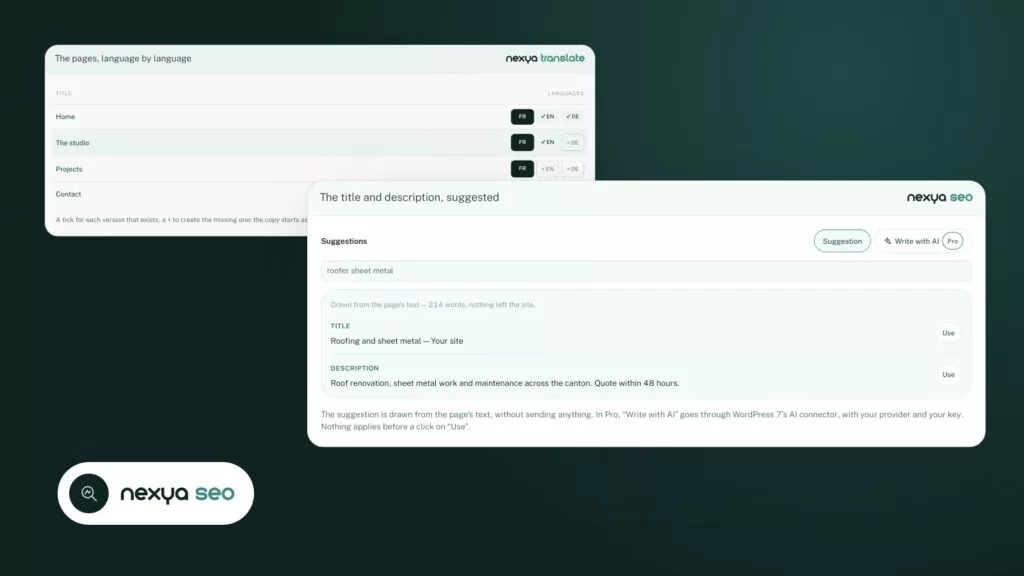
- Templates written in plain words Under each field the template is spelled out: Title · Separator · Site name. Variables are added with a click where the cursor is, instead of being copied by hand from documentation
- The markup Google expects, without duplicates A single block of structured data, where the organisation, the site, the page, the breadcrumb and the image answer each other. That is what produces the path shown under the link in the results
- Leaving Yoast takes one button Site settings, templates per content type and per taxonomy, social profiles, and the titles and descriptions written page by page. The variable syntax is the same on both sides: nothing is lost on the way
- SEO title 68 / 60
- Meta description 132 / 155
The count turns amber as soon as a length falls outside the range that shows in full. You fix a title that is too long before it gets cut, not three weeks later.
Add
Gives Title Separator Site name
Variables are added with one click where the cursor sits, and the line below reads the template back in plain words as you write it.
Nothing is stored, so nothing can go stale
SEO plugins save what they compute: a sitemap in a file, a title in a table, an index to rebuild. Then the site changes, and you have to remember to regenerate. 321 SEO does the opposite — titles, descriptions, canonicals, sitemap and llms.txt are computed when the page is requested, from the published content. There is no file to regenerate, so no file to go stale.
What it sets on every page
A title tag and a meta description, taken from the page itself or from its content type template. A canonical address that knows how to count the pages of a paginated archive. A robots directive that follows both the page setting and the site setting. Open Graph tags and X cards, with the featured image or the one chosen for sharing. And a block of structured data describing the publisher, the site, the page and its breadcrumb.
It stands aside for another plugin
As long as Yoast, Rank Math or another SEO plugin is running, the module writes nothing at all. Two plugins setting title, canonical and schema at the same time produce duplicate tags — which is worse than no SEO at all. It says so, it waits, and it takes over as soon as the other one is deactivated.
What it does not do
It does not analyse readability and does not put green lights on keywords. That kind of score measures compliance with a recipe, not the quality of a page — and pushes people to write for the tool. The optimisation report says what the site is missing to be read by a search engine: a page with no description, an image with no alternative text, unreadable addresses. Then it stops there and lets you write.
Free
Titles, descriptions, structured data, sitemap and Yoast import
Pro
Social sharing per page and per type, card preview, automatic redirect
The suite