nexya dashboard
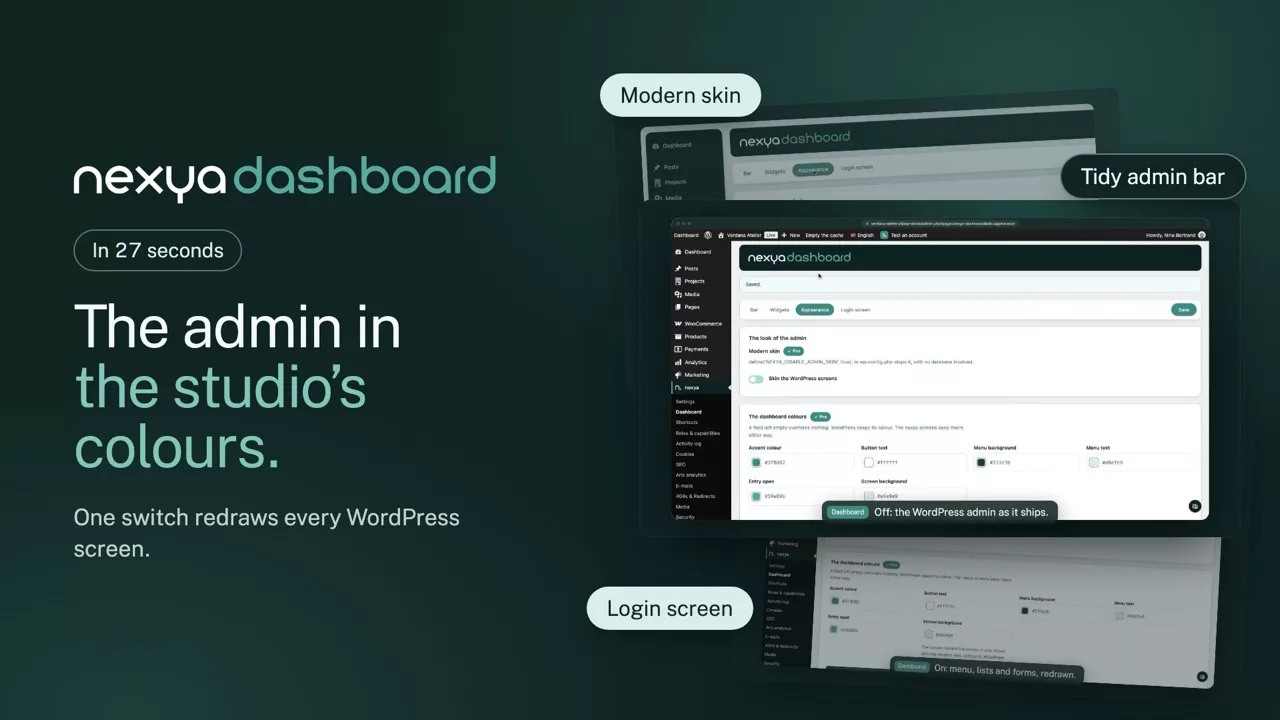
The back office as the client sees it: menus cut down to what is useful, a tidy admin bar, and the dashboard in your own colours right through to the login page
- What is not used disappears Posts, Comments, Tags, Patterns: what the site does not use does not show. The client stops wondering what half the menus are for
- A cleaned-up admin bar No Comments, no Customise, no command palette. Instead: the theme name, a Dev / Demo / Live marker, and a button to hide the bar
- It hides itself on mobile Below 782 pixels the bar disappears on load, without clicking every visit. The link to bring it back stays available
- In the agency’s colours The colours of the dashboard and the login page, the logo, the menu icons. The client logs in at home, not at WordPress
The bar and the column lift off the edges, on a soft background: this is WordPress’s furniture, dressed everywhere. The colours are set above, and the mock-up repaints as you type.
The login screen WordPress ships with: its logo, its colours, its link to wordpress.org.
The client’s logo, their colours, and the message telling them who to call. The first page they see of the back office, and sometimes the only one they see of the site.
- Logo
- Background image
- Accent colour
- Address behind the logo
- Message under the form
Pro Tidying the menu, the toolbar and the blocks is free. The branding is what a licence opens.
What a client sees in a fresh WordPress
Twenty-odd menu entries, half of which they will never use, dashboard widgets dropped in by plugins, a login page with the WordPress logo, and editing panels they will not open. None of it is broken — it is simply noise, and noise makes people hesitate.
What the module removes, and what it adds
It removes menus, secondary panels and other plugins’ dashboard widgets; any newly detected widget is hidden by default, and shown again with one click. It adds an environment marker in the bar — Dev, Demo or Live — which stops you editing the wrong site, and the agency’s colours on the dashboard and the login screen.
It does not replace permissions
Hiding an entry for everyone and hiding it for one role are two different things. This module decides what the site offers; the Roles module decides what each person can reach. They complete each other, neither makes up for the other.
Free
Trimmed menus, tidied toolbar, secondary blocks collapsed
Pro
Dashboard colours, login logo, menu icons
The suite